Who Are the Bushmen (San)?
ANTHROPOLOGY & CULTURE
A people, many communities, and a much bigger story than the stereotypes suggest.
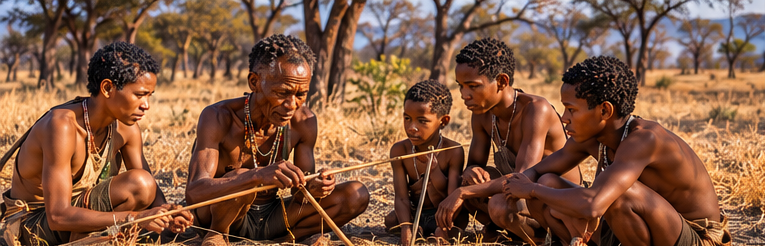
When people hear the words Bushman or San, they may immediately imagine hunter-gatherers living in the Kalahari Desert.
That image is part of a much larger and more complicated story.
The people commonly grouped under the terms Bushmen or San do not form one uniform community with a single language, history or way of life. There are numerous communities across southern Africa, with different names, languages and experiences.
Understanding that diversity is one of the best places to begin.
More Than One People
It is tempting to talk about “the Bushmen” as though the term describes one cultural and linguistic group. It does not.
There are many different Bushman/San communities. Names encountered in the literature include Ju/’hoansi, Naro, G/wi and !Xoõ, among many others.
Language makes the diversity especially clear. There is no single “Bushman language” or “San language.” Different communities speak different languages, and those languages can belong to different linguistic groupings. Some people are also multilingual.
The result is a cultural and linguistic landscape far more complicated than the single word San or Bushman might suggest.
The Kalahari and Beyond
The Kalahari occupies an important place in writing and research about Bushmen/San peoples.
Alan Barnard’s early field research took place in Botswana, and he has also carried out fieldwork in South Africa and Namibia. His work on Bushmen/San peoples spans more than four decades.
But the Kalahari should not become another stereotype. Bushmen/San communities have experienced migration, settlement, wage labor, changing political systems and changing relationships with neighboring populations. They are part of the contemporary world.

Knowledge Is at the Centre of the Story
One particularly interesting way to understand Bushman/San societies is through the idea of learning.
What does a person need to know to understand the environment around them? How do people recognize plants and animals? How is knowledge of changing seasons acquired? How do children learn about relationships, stories, beliefs and social expectations? And how does one generation pass knowledge to another?
These questions are central to Alan Barnard’s The Bushmen (San) of Africa: More than 40,000 Years of Learning.
Barnard describes learning during his time in the Kalahari about botany, zoology, seasons, time and the environment. He also learned about kinship, religion, politics and economics.
That gives us a much richer question than simply asking how people survived in the Kalahari.
How do human beings learn to understand their world?
Why Study Bushmen/San Peoples?
Studying Bushmen/San peoples can open much broader questions about humanity.
How does language develop and change? How do societies organize relationships? How is food shared? How is environmental knowledge preserved? How do people understand religion and the world around them? And how do communities respond when their circumstances change?
The answers cannot be reduced to one community or one historical period. Bushmen/San societies are diverse, and descriptions of one community should not automatically be assumed to describe another.
People, Not Remnants of the Past
Bushmen/San people should not be presented as though they are surviving examples of prehistoric humanity.
Archaeology can help us investigate southern Africa’s distant past. Anthropology can document societies and social change. Linguistics can reveal remarkable language diversity.
But contemporary Bushmen/San people have contemporary lives. Their cultures have histories. Their circumstances change. Their identities are not museum exhibits.
Studying them therefore offers something much more valuable than a supposed glimpse of a “primitive” past. It gives us an opportunity to explore the complexity of human knowledge, language, society and learning.
Next article: Bushman or San: What Should We Call Them?