Bushman or San: What Should We Call Them?
Why the terminology is more complicated than choosing the “correct” word.

Should we say Bushman or San?
At first glance, this might seem like a question with a straightforward answer.
Choose the most respectful modern term, use it consistently and avoid the other.
But the reality is considerably more complicated.
Neither term provides a perfect universal solution, and preferences can differ according to community, language and context.
There Is No Single Indigenous Name Covering Everyone
One reason terminology becomes difficult is that the people grouped under these broad labels do not form one linguistic community.
There are numerous peoples and languages.
Neither “Bushman” nor “San” is simply the universal name that all these communities traditionally used for themselves.
That makes searching for one supposedly correct label difficult.
A single name inevitably simplifies a much more diverse reality.
What About “San”?
San is now widely encountered in academic, governmental and public contexts.
However, the word itself comes from Khoekhoe rather than being a universal self-designation originating in all the communities to which it is now applied.
The term therefore has a history of its own.
Simply replacing every occurrence of Bushman with San does not resolve the entire question.
Identity Changes With Context
Alan Barnard's discussion includes an illuminating example from Kuela Kiema, a scholar and musician who is himself from a Bushman/San community.
Kiema describes using different identifiers depending on the people he is speaking with and the language being used.
In different circumstances, terms such as Kua, Mosarwa, Dcuikhoe, Bushman and San may appear.
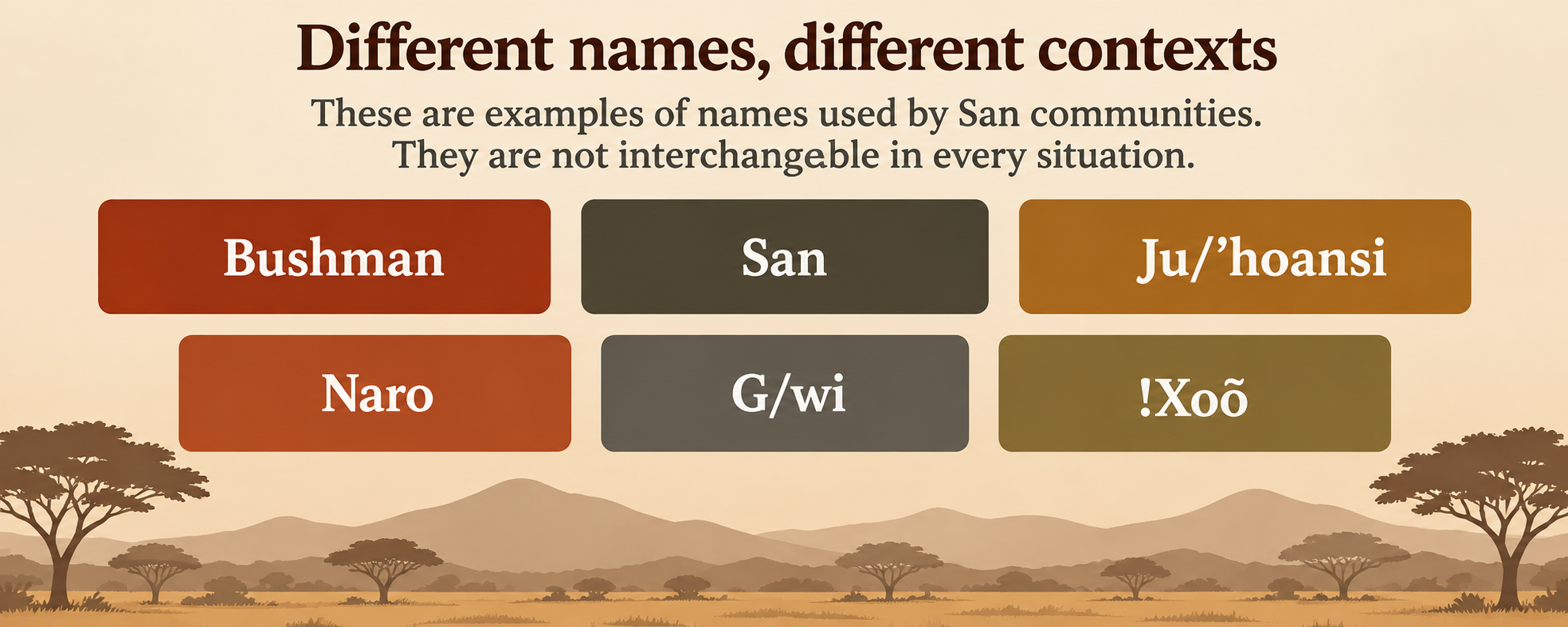
So Which Term Will This Publication Use?
Throughout this publication, you will encounter both Bushman and San.
We may use Bushmen/San or Bushman (San) when referring broadly to the subject.
When discussing a particular people or language community, we will use the more specific name whenever appropriate.
That might mean Ju/’hoansi, Naro, G/wi, !Xoõ, or another relevant name.
Historical terminology may also appear when discussing older documents and scholarship.
The aim is not to pretend that the terminology is simpler than it actually is.
It is to explain the context.
Words Carry History
Names are never merely labels.
They can contain histories of relationships between peoples, colonial administration, academic classification, language and changing ideas about identity.
That makes the disagreement over terminology interesting in its own right.
It encourages us to ask:
Who has the authority to name a people?
Does a name mean the same thing in every language?
Can a label originally given by outsiders later become a chosen identity?
And what happens when people grouped under the same broad term prefer different names?
There may never be one answer that applies universally.
Perhaps the most respectful approach is therefore not to search endlessly for a single perfect word.
It is to pay attention to who is being discussed, what they call themselves, and the context in which a name is being used.
Next: The Languages of the Bushmen/San